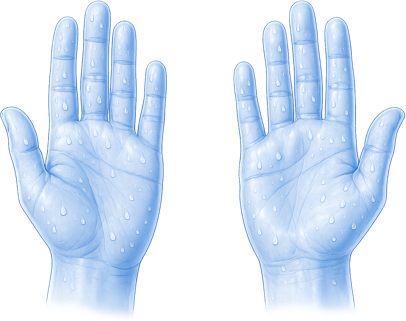
What it is
The exact cause of primary hyperhidrosis is not fully understood, but it is thought to result from overactive nerve signals travelling through a chain of nerves in the chest to the sweat glands. These signals cause sweating when it is not needed to regulate your body temperature.
Sweating may be triggered by situations such as meeting new people, speaking in public, interviews or other moments of stress or excitement, but it can also happen without any obvious trigger. Primary hyperhidrosis often begins in childhood or early adulthood and can run in families.
It is important to distinguish this from secondary hyperhidrosis, where excessive sweating is caused by another condition or medication. Examples include an overactive thyroid, hormonal changes such as the menopause, some infections and certain medicines. Secondary sweating is more likely to affect the whole body or occur at night and is treated by addressing the underlying cause.
Common symptoms
Hyperhidrosis affects people differently. What matters most is not simply how much you sweat, but how much it interferes with your everyday life, work and confidence. Patients with hyperhidrosis commonly experience:
- Excessive sweating even when you are not hot or exercising
- Wet, cold or dripping hands
- Sweating that soaks through clothing
- Difficulty handling paper, using a phone or gripping objects
- Avoiding handshakes or feeling self-conscious in social or professional situations
Treatment approach
Treatment usually follows a step-by-step approach, starting with non-surgical options such as prescription antiperspirants, tablets, iontophoresis or Botox, depending on where and how severely you sweat. These treatments can be very effective, and surgery is generally considered only when appropriate non-surgical treatments have not provided sufficient relief.
For some patients, however, excessive sweating continues to have a significant impact on everyday life despite treatment. Endoscopic thoracic sympathectomy (ETS) is a minimally invasive VATS (keyhole) operation that interrupts the nerve signals responsible for excessive sweating. It is usually performed through two small 5 mm incisions on each side, positioned discreetly beneath the armpit/breast area. The exact nerves treated are tailored to your pattern of sweating. The effect on hand sweating is usually immediate, and most patients are able to go home the same day.
The main side effect is compensatory sweating — increased sweating elsewhere on the body after surgery. The likelihood and potential impact of this, as well as your individual chance of benefiting from ETS, will be discussed carefully with you before deciding whether surgery is right for you.