Slipping rib syndrome — the Hansen repair
In slipping rib syndrome, the cartilage connecting the lower ribs becomes unusually mobile, allowing one or more ribs to move against or underneath the rib above and irritate the nearby nerves. This can cause persistent pain, sometimes with a clicking or slipping sensation.
The Hansen repair is performed through a small incision over the affected ribs. Strong, permanent stitches are used to stabilise the slipping rib and prevent the abnormal movement responsible for the pain, while preserving the natural flexibility of the chest wall.
The repair needs time to heal, so heavy lifting, twisting and strenuous exercise should usually be avoided for 6–8 weeks.
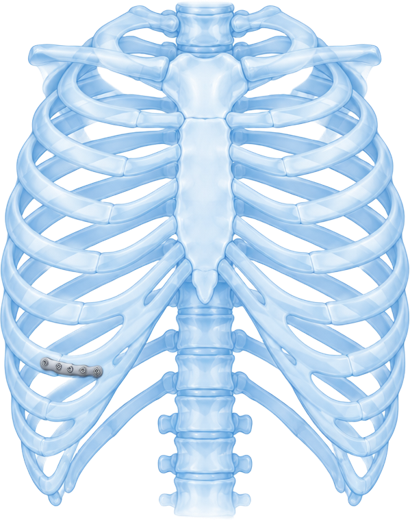
The upper seven ribs attach directly to the breastbone. Ribs 8–10 are joined to each other by flexible cartilage, which is where slipping rib syndrome occurs.
Rib fixation
Badly displaced rib fractures, or fractures that have failed to heal (non-union), can cause ongoing pain and instability. These ribs can be realigned and stabilised with low-profile titanium plates, which usually stay in place permanently.
Chest wall reconstruction
When part of the chest wall must be removed — for example for a tumour — it can be reconstructed with mesh or plates to restore stability and protect the lung.