Mr Harrison's approach
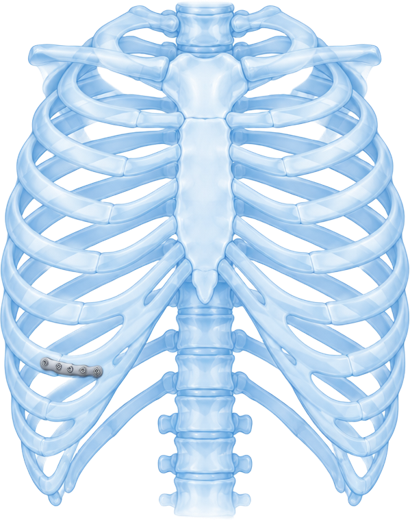
For lung resections, Mr Harrison usually uses a technique known as the Copenhagen three-incision approach. This involves two small incisions of approximately 1 cm lower down on the side of the chest, together with a slightly larger incision of around 3 cm higher up, positioned between the muscles of the chest wall. The muscles are gently separated rather than cut, and the ribs do not need to be spread apart.
For pneumothorax and many pleural procedures, Mr Harrison can often perform the operation through a single small incision, known as uniportal VATS. Both the camera and surgical instruments are introduced through this same opening.
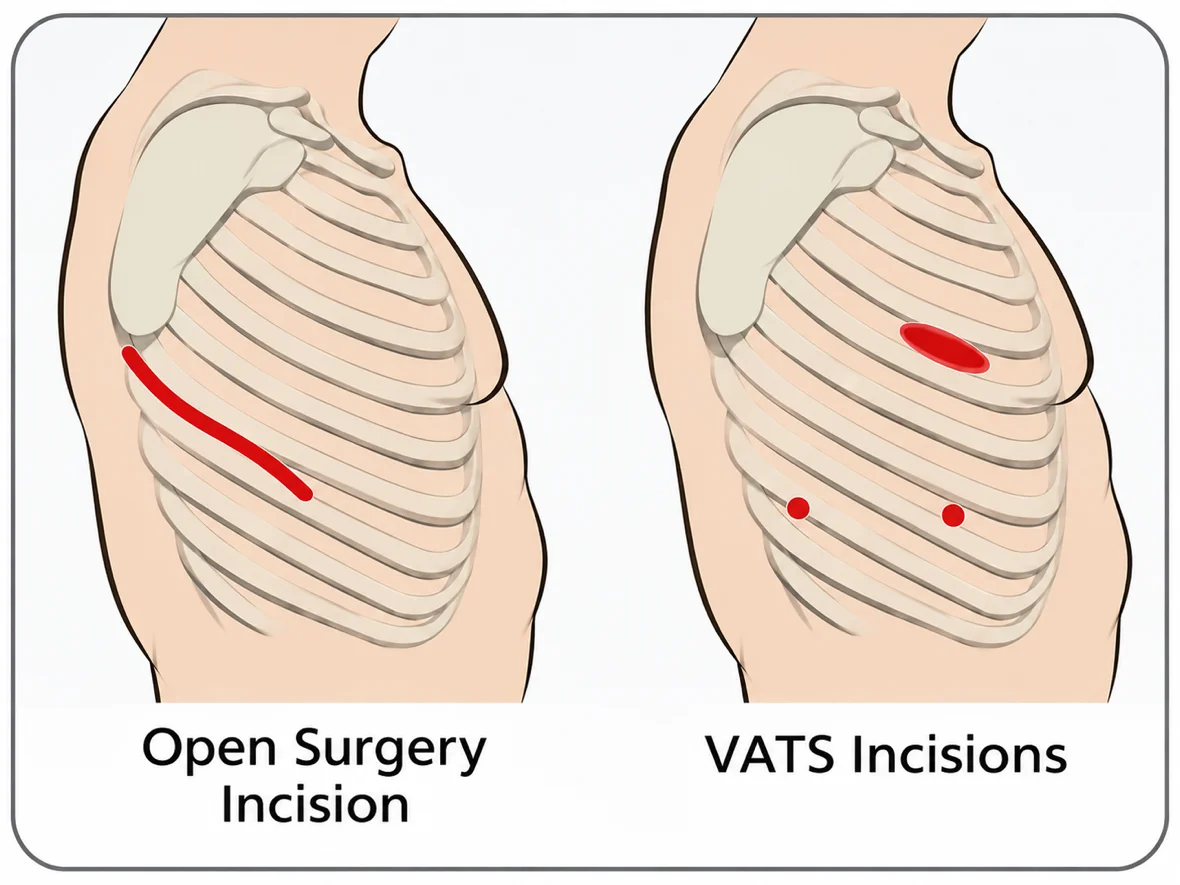
Patient lying on their left side, viewed from the side: head at the top, feet at the bottom, front of the chest to the right and back to the left.
For lung resections, Mr Harrison uses the Copenhagen three-incision VATS technique. This involves one incision of approximately 3 cm higher on the side of the chest and two smaller incisions of around 1 cm lower down. The incisions are carefully positioned between the muscles, which are separated rather than cut, without the need to spread the ribs apart as in traditional open surgery.
Operations performed with VATS
VATS is used for a wide range of operations, including:
- Surgery for pneumothorax (bullectomy and pleurodesis)
- Pleural biopsy, drainage and talc pleurodesis
- Decortication for empyema
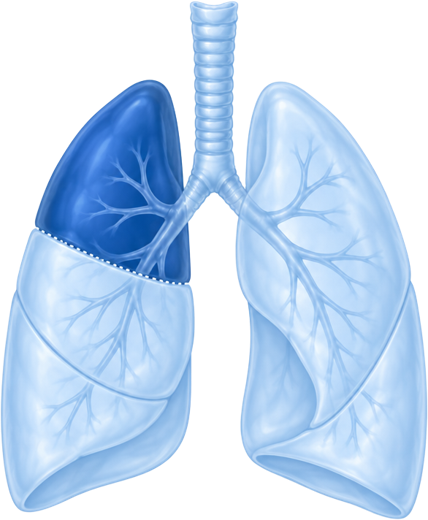
- Wedge resection, segmentectomy and lobectomy
- Sympathectomy (ETS) for hyperhidrosis
After the operation
Most patients are up and walking the same day or the day after surgery. A chest drain is usually placed through one of the incisions for a short time, and the small wounds are closed with dissolvable stitches.
For more on what to expect in the days and weeks afterwards, see recovery after lung surgery.